
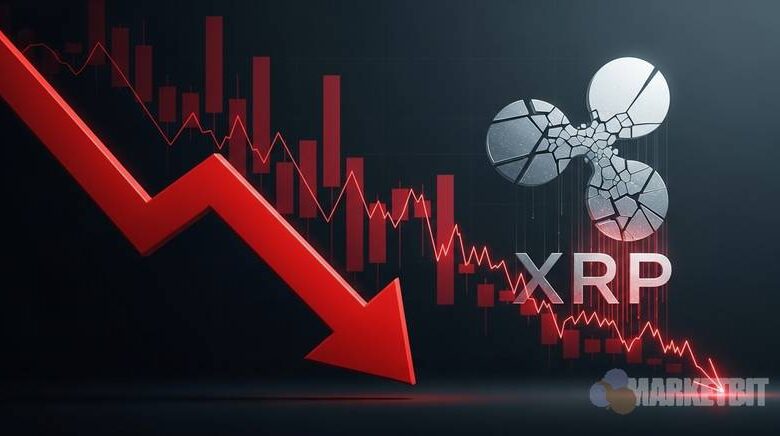
XRP Ledger payment activity has roughly halved over the past three weeks, dropping from over 1.6 million daily payments to under 800,000, even as XRP’s spot price declined only about 2.85% in the last 24 hours. The divergence between collapsing on-chain usage and relatively stable token pricing raises pointed questions about XRP Ledger’s market structure and whether the network’s fundamentals are deteriorating faster than the market is pricing in.
A widely circulated headline framed the decline as a “50% loss in 24 hours,” but the underlying data tells a more nuanced story. The drop refers to on-chain payment activity on the XRP Ledger, not a crash in XRP’s token price. That distinction matters for anyone trying to assess what is actually happening on the network.
Why a 50% Drop in XRPL Payment Activity Matters
XRPSCAN on-chain metrics show that XRPL payments_count fell from 1,600,562 on February 27 to 799,155 on March 21, 2026. That is a decline of approximately 50.07% over roughly three weeks, not a single 24-hour window as the headline implied.
The decline was not limited to payment counts. Active accounts on the ledger fell from 19,037 to 12,035 over the same period, a drop of about 36.78%. Payments volume collapsed even more sharply, falling from 900.64 million to 72.90 million XRP.
U.Today’s Arman Shirinyan wrote that “you cannot dismiss the roughly 50% decline,” framing the metric deterioration as a fundamental warning sign rather than temporary noise. The original U.Today report was titled “XRP Lost 50% in Fundamental On-Chain Metric, But Beware,” reinforcing that this is about ledger usage, not token price.
A one-day 50% loss in any metric would be alarming on its own. But the fact that this decline unfolded over several weeks, with payment counts, active accounts, and volume all falling in tandem, points to a sustained trend rather than an isolated shock. That pattern is what separates a short-term anomaly from a potential structural weakness.
Meanwhile, XRP traded at $1.40, down just 2.85% over 24 hours, with a market cap of roughly $86 billion and 24-hour trading volume near $1.75 billion. The gap between shrinking network activity and stable spot pricing is the core tension in this story.
What ‘Problematic Market Structure’ Could Mean for XRP
In crypto terms, market structure encompasses liquidity depth, participant diversity, and the quality of price discovery across venues. A healthy market structure typically shows alignment between network usage and market valuation. When these diverge sharply, it can signal that pricing is being sustained by speculative trading rather than fundamental demand.
When on-chain activity drops by half while the token price barely moves, it suggests that price discovery may be happening primarily on centralized exchanges rather than through organic network usage. This is what market observers mean when they flag a “problematic market structure.”
The XRPL data suggests exactly this kind of divergence. Payment counts and active accounts are trending down significantly, yet the token’s price has remained relatively stable. That pattern can persist for extended periods, but it also makes the asset more vulnerable to sudden corrections if speculative interest fades. Similar dynamics have played out across the broader crypto market, where exploit-driven depegs and sudden liquidity withdrawals have exposed structural fragility in other protocols.
It is important to separate what the data confirms from what it does not. The decline in XRPL payment counts is verified and substantial. Whether this reflects a permanent shift in network usage or a temporary pullback tied to broader market conditions remains an open question. The headline suggests a hint of structural trouble, not definitive proof, and readers should weigh it accordingly.
No fresh regulatory catalyst was identified that would explain the drop. The decline appears driven by weakening organic network activity and broader crypto risk aversion rather than any specific enforcement action, a contrast to the regulatory headwinds facing other corners of the industry.
What Traders and Investors Should Watch Next
The XRPL activity decline is unfolding against a backdrop of extreme market-wide fear. The Fear and Greed Index sat at 10, labeled “Extreme Fear,” on March 22. That reading suggests the drop in XRP Ledger usage is at least partially connected to a broad risk-off environment rather than an XRP-specific crisis.
CoinGecko user sentiment data offered a counterpoint: 82.81% of XRP voters on the platform maintained a bullish stance versus 17.19% bearish. Retail sentiment has not capitulated on XRP itself, even as on-chain fundamentals weaken. This disconnect echoes patterns seen in other markets where conviction-driven accumulation persists alongside deteriorating short-term metrics.
The 50% decline in XRPL payment activity is a confirmed data point, but its implications depend on what happens next. A structural breakdown looks different from a temporary dip, and the next few weeks of data will help distinguish between the two.
What to Know
- Watch XRPL payments_count and active_accounts weekly. If both continue declining through April, the structural concern gains weight. Stabilization or recovery would suggest a temporary pullback.
- Monitor spot volume quality. Sustained trading volume on centralized exchanges without corresponding on-chain activity growth would reinforce the market structure imbalance regulators have flagged across the industry.
- Track broader sentiment recovery. At 10, the Fear and Greed Index is near historic lows. A recovery in general crypto sentiment that does not lift XRPL usage would isolate the problem to XRP specifically.
The headline claim of a “50% loss in 24 hours” overstates the timeframe, but the underlying decline is real and documented. XRPL payment activity has roughly halved over three weeks while XRP’s price has barely moved. Whether that divergence corrects through a price adjustment, a usage recovery, or simply persists as a new normal is the question that matters now.
Disclaimer: This article is for informational purposes only and does not constitute financial or investment advice. Cryptocurrency and digital asset markets carry significant risk. Always do your own research before making decisions.