
| What to Know: - Bitcoin ETF outflows spurred rotation into RWAs as a defensive allocation. - RWAs package familiar instruments with compliance guardrails, targeting stable, modelable cash yields. - Reduced mark-to-market volatility made RWAs preferable to broad crypto beta. |
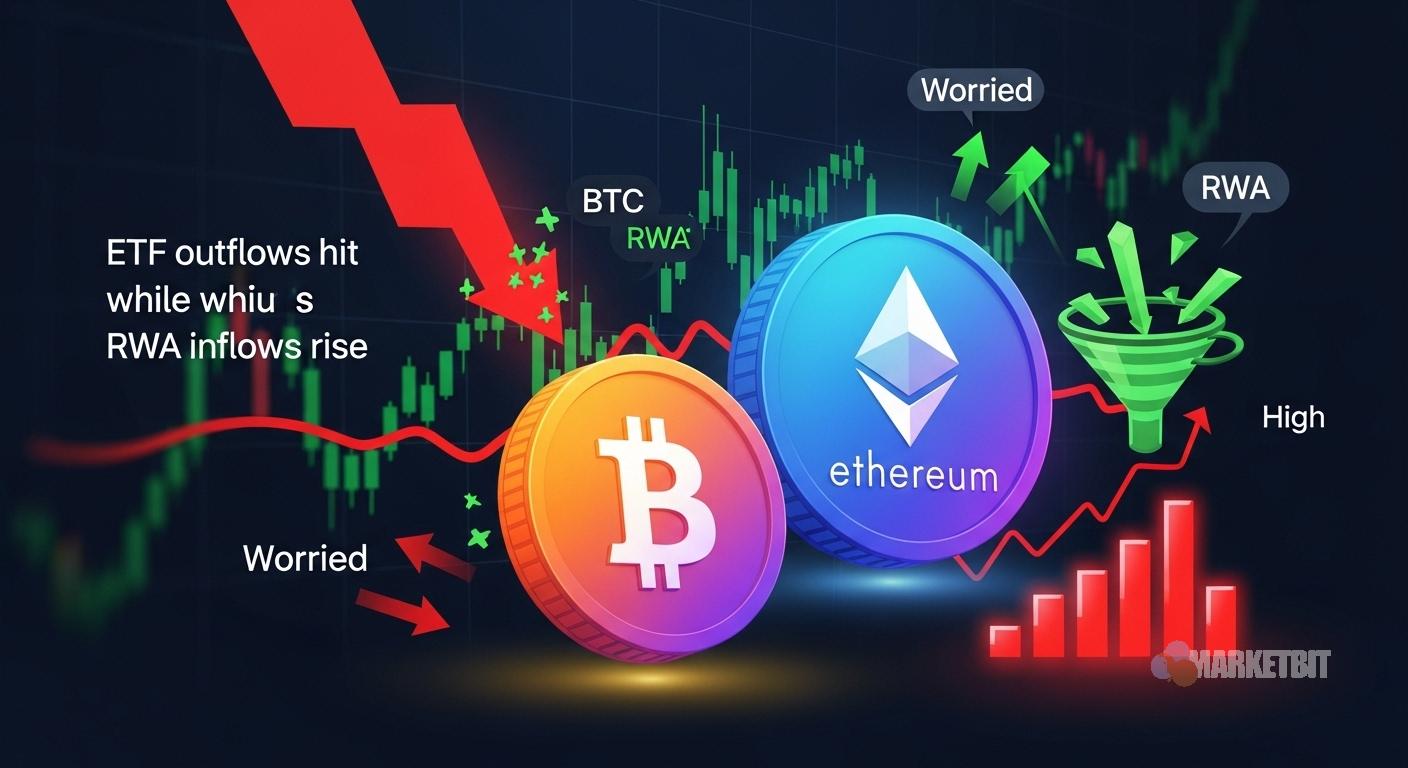
Tokenized real-world assets were the rare narrative to draw increasing liquidity during the past month despite a broader crypto price downturn, as reported by CryptoRank. The divergence emerged even as Bitcoin ETF outflows weighed on sentiment across digital-asset funds.
U.S. spot Bitcoin ETFs recorded about $3.3 billion in net outflows in February 2025, as reported by Bloomberg, citing risk aversion tied to geopolitical and inflation concerns. The pattern signaled risk trimming rather than a wholesale exit from the ecosystem.
Based on data from Glassnode, 30-day averages indicate persistent ETF outflows for Bitcoin and Ethereum, reflecting sustained caution among larger investors. In that environment, allocators often favor assets with modelable cash flows and lower drawdown risk.
RWAs absorbed liquidity because they package familiar instruments, Treasuries, private credit, real estate, and commodities, into tokens that settle on public chains while maintaining compliance guardrails. That structure lets managers target stable yield and reduce mark-to-market volatility versus broad crypto beta.
The on-chain RWA TVL also rose on a trailing year basis, reaching about $10.6 billion in April 2025 from $4.4 billion a year prior, based on data from DeFiLlama. The figures capture tokenized exposure where collateral may be held off-chain but referenced and serviced on-chain.
RWA tokenization issues blockchain tokens representing legal claims on off‑chain assets, typically via a special purpose vehicle. Tokens often embed transfer restrictions, while oracles publish NAV and cash‑flow data to reconcile on‑chain state with traditional records.
The model matters now because it pairs predictable yield with instant settlement and programmability, while preserving KYC/AML and investor‑qualification workflows. Leading categories include tokenized Treasuries, private credit facilities, tokenized real estate, and asset‑backed commodities such as gold.
According to Cointelegraph, large financial institutions including BlackRock and JPMorgan have increased activity around tokenization, and one executive projected on‑chain RWA TVL could surpass $50 billion in 2025 if momentum endures. Institutional signaling, coupled with improvements in oracle, custody, and audit infrastructure, is lowering operational friction for allocators.
Industry operators also frame RWAs as a stabilizer inside crypto portfolios when volatility spikes. “RWAs, especially fixed income, provide exactly that: a portfolio hedge against crypto volatility.” , Bhaji Illuminati, CMO at Centrifuge.
At the time of this writing, MicroStrategy’s shares had fallen roughly 26% over the past month while the firm added 2,486 BTC, based on data from Yahoo Finance. The juxtaposition underscores a cautious risk posture and the appeal of yield‑bearing, compliance‑ready instruments during drawdowns.
Disclaimer:
Marketbit.io provides cryptocurrency news, alerts, commentary, and entertainment content for informational purposes only. Nothing published on this site constitutes financial, investment, legal, or trading advice. Cryptocurrency markets are highly volatile and involve substantial risk, including the potential loss of capital. Always conduct your own research (DYOR) and consult with a qualified financial professional before making any investment decisions.