
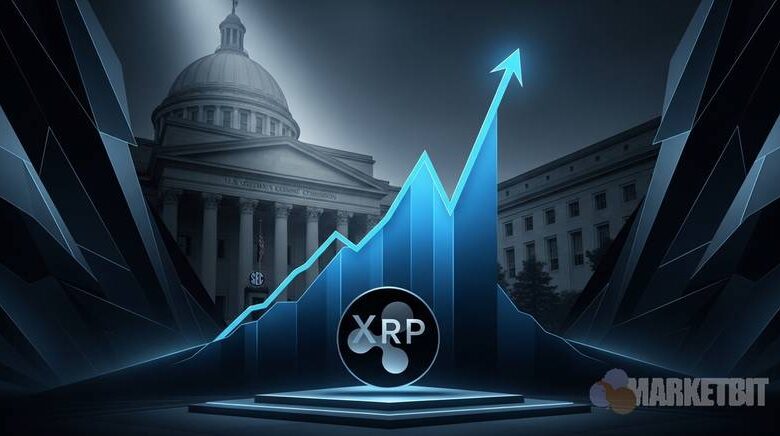
XRP is climbing away from levels last seen in 2021 after the SEC and CFTC jointly classified it as a digital commodity in a landmark interpretive release. The March 17 guidance, which created a formal token taxonomy for the first time, explicitly named XRP alongside Bitcoin, Ether, Solana, and over a dozen other tokens as assets that fall under commodity oversight rather than securities law.
XRP Shakes Off Multi-Year Lows on Regulatory Clarity
The rebound from 2021-era price levels marks a notable shift for an asset that spent years weighed down by regulatory uncertainty. For XRP holders, escaping a multi-year floor signals more than a routine bounce; it reflects a repricing of the legal risk that had lingered since the SEC first sued Ripple Labs in December 2020.
Recovery from such prolonged lows tends to attract broader market attention. Traders who sat on the sidelines during the Ripple litigation now face a fundamentally different classification landscape, one where XRP carries an official commodity label from both major U.S. financial regulators.
The timing aligns with a wider uptick in crypto market confidence. Hardware wallet maker Ledger recently announced a major U.S. expansion, signaling that institutional infrastructure providers see growing demand in the current environment.
SEC and CFTC Jointly Name XRP a Digital Commodity
On March 17, 2026, the SEC published Interpretive Release No. 33-11412, establishing a token taxonomy that sorts crypto assets into defined categories. The “digital commodities” bucket explicitly lists XRP, along with Bitcoin, Ether, Solana, Cardano, Dogecoin, Chainlink, Avalanche, and several others.
The CFTC joined the interpretation, stating it would administer the Commodity Exchange Act consistently with the new framework. This joint posture is significant because it eliminates the jurisdictional ambiguity that plagued XRP for years, where neither agency offered a definitive classification.
SEC Chairman Paul S. Atkins framed the move in direct terms in the accompanying press release.
“This is what regulatory agencies are supposed to do: draw clear lines in clear terms.”
The classification builds on earlier groundwork. A February 2025 CFTC product-certification filing had already argued that XRP qualifies as a non-security commodity when sold on third-party exchanges, citing the Ripple court ruling as precedent.
It is worth distinguishing what this guidance is and what it is not. The release is an interpretive statement, not a new statute. It represents the agencies’ official reading of existing law while Congress continues working on broader market-structure legislation. The SEC itself described the interpretation as a bridge to eventual congressional action.
Legal observers have noted the coordinated approach. Norton Rose Fulbright wrote on March 11 that recent SEC and CFTC actions signal a more coordinated and rules-based approach to digital asset oversight, a departure from the enforcement-first posture of prior years.
Why the Commodity Label Reshapes XRP’s Regulatory Profile
For crypto markets, the distinction between “security” and “commodity” carries enormous practical weight. Securities face registration requirements, trading restrictions, and disclosure obligations under the SEC. Commodities, by contrast, trade under the lighter-touch CFTC regime, which historically has been more accommodating to spot-market crypto activity.
XRP’s years-long entanglement with the SEC made it a case study in classification risk. Exchanges delisted it, institutional allocators avoided it, and the token consistently traded at a discount to its technical fundamentals. An official commodity designation removes the core legal overhang that drove those decisions.
The XRP Treasury plan that recently faced scrutiny could also take on new dimensions under the commodity framework, as regulatory clarity tends to unlock more structured financial products and institutional participation.
Michael S. Selig, a crypto-focused attorney, captured the market’s sentiment in the SEC’s press release: “With today’s interpretation, the wait is over.”
What the Classification Means for Trader Sentiment
Regulatory headlines have historically been among the most powerful catalysts for XRP price movement. The token surged after partial victories in the Ripple case and sold off sharply on negative court rulings. A joint SEC-CFTC commodity designation is the most definitive regulatory signal XRP has received to date.
The immediate effect is a shift in narrative. XRP moves from “token fighting an SEC lawsuit” to “officially recognized digital commodity,” a framing that opens doors for ETF applications, derivatives products, and broader exchange re-listings.
Axios reported on March 19 that federal regulators officially announced the new crypto treatment, reinforcing the breadth of media coverage driving awareness to the classification change.
The broader crypto market stands to benefit as well. With 16 tokens now explicitly classified as digital commodities, the interpretive release provides a template that other projects can reference. The move echoes a period of growing institutional comfort, as evidenced by events like a post-Satoshi era Bitcoin wallet emerging with $147.6 million in BTC, highlighting renewed activity from long-dormant holders.
Traders should note the limits of what has changed. The interpretation does not guarantee that Congress will codify the same framework in final legislation. It also does not address every token; assets not on the named list still face classification uncertainty. And market conditions can reverse regardless of regulatory tailwinds.
For XRP specifically, the combination of a multi-year price recovery and a formal commodity label from both U.S. regulators represents the strongest fundamental setup the token has had since its 2018 peak. Whether that translates into sustained upside depends on follow-through from exchanges, institutional products, and the legislative process that the SEC itself acknowledged is still underway.
Disclaimer: This article is for informational purposes only and does not constitute financial or investment advice. Cryptocurrency and digital asset markets carry significant risk. Always do your own research before making decisions.