
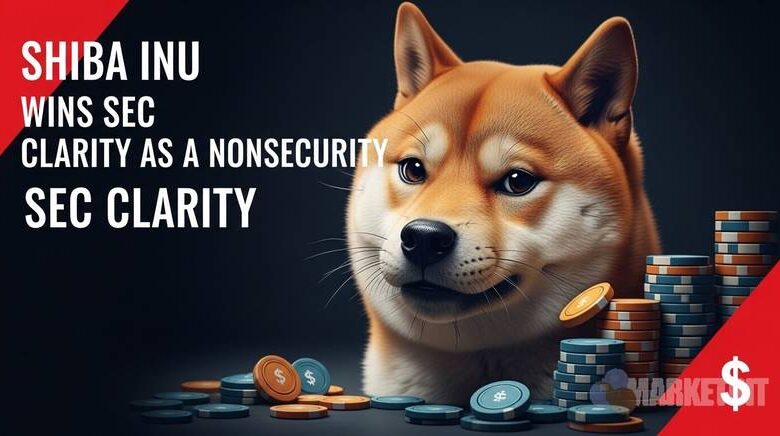
Shiba Inu stands to benefit from a broader SEC staff statement that classified certain meme coins as nonsecurity assets, though the agency never issued a SHIB-specific ruling. The February 2025 statement from the SEC’s Division of Corporation Finance offered the clearest regulatory signal yet for meme tokens, but its limits matter just as much as its reach.
What SEC clarity means for Shiba Inu
On February 27, 2025, the SEC’s Division of Corporation Finance published a staff statement on meme coins declaring that the types of meme coins it described “do not involve the offer and sale of securities under federal securities laws.” The staff compared such tokens to collectibles, noting their value is driven primarily by market demand and speculation rather than any expectation of profit from the efforts of others.
For SHIB holders, the practical takeaway is straightforward. If Shiba Inu fits the staff statement’s description of a meme coin with limited or no functionality whose value rests on speculation, it would fall outside the securities framework the SEC typically uses to regulate token offerings.
That distinction matters because securities classification triggers registration requirements, disclosure obligations, and potential enforcement actions. Nonsecurity status removes those hurdles, allowing tokens to trade on exchanges without the compliance burden that has forced some platforms to delist certain altcoins in recent years.
There is, however, a critical caveat. The staff statement is non-binding and carries no legal force. It does not represent an official Commission position, and it explicitly warns that “a definitive determination for any specific meme coin requires analyzing the specific facts and the manner in which it is offered and sold.”
Commissioner Caroline Crenshaw criticized the statement the same day it was published, arguing it was too broad. She stressed that whether any individual token qualifies as a security depends on a facts-and-circumstances analysis, not a blanket category exemption. No SEC document has ever named SHIB specifically as a nonsecurity asset.
Commissioner Hester Peirce offered a different reading, describing the statement as part of an effort to provide clarity about what is not in the SEC’s jurisdiction. That internal disagreement underscores that the regulatory picture is evolving, not settled.
Why the decision matters for SHIB trading and exchange access
Regulatory uncertainty has been the single largest overhang on crypto exchange operations since 2023. Platforms operating in the United States face pressure to evaluate every listed token against securities law, and ambiguity has often led to preemptive delistings rather than risk enforcement.
The staff statement shifts that calculus for tokens that clearly fit the meme-coin description. Exchanges can point to the SEC’s own language when justifying continued support for assets like SHIB, reducing compliance friction and potentially stabilizing liquidity for those pairs.
For traders, the signal is more about access than price direction. Continued listing availability on major platforms means tighter spreads, deeper order books, and fewer disruptions. The broader regulatory environment for crypto assets remains in flux, but nonsecurity classification removes one of the more immediate threats to exchange access.
Market participants should note that regulatory clarity does not equal regulatory immunity. The SEC retains authority to revisit individual tokens, and the staff statement’s non-binding nature means a future Commission could take a different view. Price reactions to regulatory headlines often overshoot in both directions, and the gap between a general staff statement and a token-specific safe harbor is wide.
Short-term sentiment around SHIB may improve on the headline alone. But informed traders will recognize the difference between a favorable general signal and a definitive legal shield.
What this could signal for other altcoins
The meme-coin staff statement establishes a framework, not a precedent in the legal sense. It describes characteristics, such as limited functionality and speculation-driven value, that could apply to dozens of tokens beyond SHIB. Meme tokens with similar profiles may benefit from the same reasoning.
That said, one asset’s favorable positioning does not automatically extend to all tokens. The SEC’s emphasis on facts-and-circumstances review means each token could face different treatment based on how it was marketed, what utility it claims, and whether holders have a reasonable expectation of profit from a third party’s efforts. Tokens with staking rewards, governance functions, or revenue-sharing mechanisms may not fit the narrow meme-coin description at all.
For the broader altcoin market, the statement’s real significance may be directional. It suggests the SEC under its current leadership is willing to carve out categories of tokens that fall outside securities law, rather than treating all crypto assets as potentially regulated instruments. That posture could eventually benefit other token classes if similar staff statements follow.
Investors watching whale positioning across major altcoins should weigh regulatory signals alongside on-chain and market data. A favorable SEC staff statement is one input, not the whole picture.
For SHIB specifically, the path forward depends on whether the broader meme-coin framework hardens into something more durable, whether through formal rulemaking, no-action letters, or court decisions that reference the staff’s reasoning. Until then, the February 2025 statement is the strongest regulatory tailwind meme tokens have received, even if it falls short of the definitive clearance the headline suggests.
Disclaimer: This article is for informational purposes only and does not constitute financial or investment advice. Cryptocurrency and digital asset markets carry significant risk. Always do your own research before making decisions.